The 7 Chakras Explained — and How Dowsing Checks Them
By Narinder, Vedic astrologer · Updated · 5 min read

Key takeaways
- 7 chakras, root to crown: stability → creativity → confidence → love → expression → intuition → peace.
- Each has a colour, element and bija mantra (LAM, VAM, RAM, YAM, HAM, OM).
- Imbalance shows up, traditionally, as patterns in mood and behaviour — not as a diagnosis.
- Dowsing reads each chakra; balancing uses breath, sound, intention and small habits.
- It's a complementary, reflective practice — not a replacement for medical care.
In this article
The seven chakras are energy centres described in yogic tradition, running along the spine from the base to the top of the head: Root (Muladhara), Sacral (Svadhisthana), Solar Plexus (Manipura), Heart (Anahata), Throat (Vishuddha), Third Eye (Ajna) and Crown (Sahasrara). Each is linked with a colour, an element and a theme — from safety and stability at the root to peace and connection at the crown. In a dowsing session, a pendulum is held over each chakra to see which feel balanced, under-active or over-active, and simple practices are suggested.
Chakras are one of the most searched — and most confusing — ideas in wellness. Here's a plain, honest guide: what each chakra stands for, what "blocked" usually means in practice, and what a dowsing check actually involves.
The 7 Chakras at a Glance
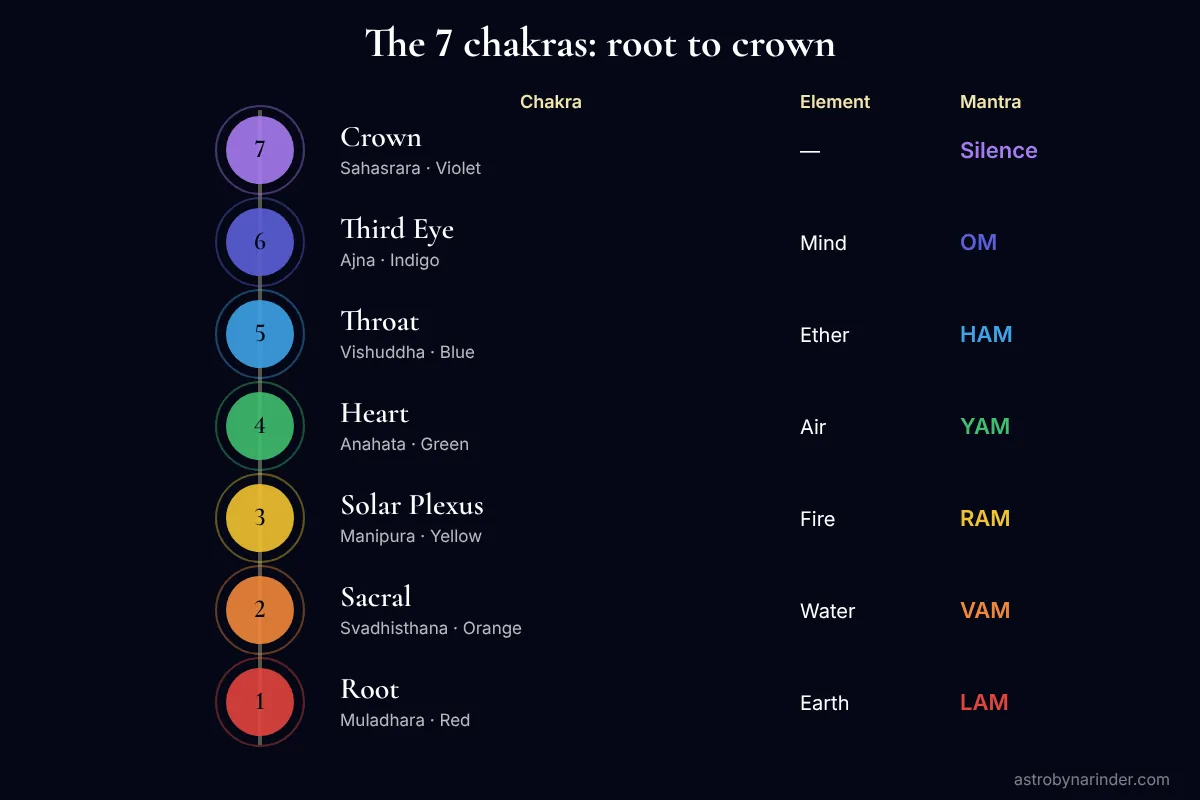
| Chakra | Location | Colour | Element | Bija mantra | Theme |
|---|---|---|---|---|---|
| Root (Muladhara) | Base of spine | Red | Earth | LAM | Safety, stability, money basics |
| Sacral (Svadhisthana) | Lower belly | Orange | Water | VAM | Creativity, emotions, pleasure |
| Solar Plexus (Manipura) | Upper belly | Yellow | Fire | RAM | Confidence, willpower |
| Heart (Anahata) | Centre of chest | Green | Air | YAM | Love, compassion, forgiveness |
| Throat (Vishuddha) | Throat | Blue | Ether (space) | HAM | Expression, truth |
| Third Eye (Ajna) | Between the brows | Indigo | — (mind) | OM | Intuition, clarity |
| Crown (Sahasrara) | Top of the head | Violet / white | — | Silence | Connection, peace |
What "Blocked" or "Imbalanced" Means
In tradition, a chakra can be under-active (too little of its quality) or over-active (too much). Commonly described patterns:
| Chakra | Under-active | Over-active |
|---|---|---|
| Root | Anxious, ungrounded | Rigid, holding on |
| Sacral | Flat, uncreative | Emotional swings |
| Solar Plexus | Low confidence | Controlling |
| Heart | Closed off | People-pleasing |
| Throat | Can't speak up | Talking over others |
| Third Eye | Confused, indecisive | Overthinking |
| Crown | Disconnected | Detached from daily life |
These are reflective prompts, not diagnoses. Ongoing anxiety, low mood or physical symptoms deserve a doctor or therapist.
How Dowsing Checks the Chakras
- Calibration — the pendulum's "yes" and "no" swings are set.
- Scan — the pendulum is held over each chakra, root to crown, and the movement noted (balanced, weak, or very strong).
- Balancing — a calm process with breath, intention, sound (bija mantras) and sometimes crystals or colour.
- Re-check — the scan is repeated to see the change.
- Suggestions — two or three small practices for the coming days.
Sessions are done at a distance — you stay at home. For the basics of the pendulum, read What Is Pendulum Dowsing?
Simple Practices for Each Chakra
- Root: walk barefoot on grass, a fixed daily routine, red foods.
- Sacral: creative hobbies, swimming or water time.
- Solar plexus: small goals completed daily, morning sunlight.
- Heart: gratitude, time with loved ones, forgiveness journaling.
- Throat: say one honest thing a day, humming or chanting HAM.
- Third eye: 10 minutes of quiet focus, less screen time at night.
- Crown: silence, meditation, time in nature.
A Worked Example
An example session (not a real client): someone feeling unable to speak up at work and tired all day.
- Scan: throat weak, root weak, solar plexus over-active (pushing hard but stuck).
- Balancing with breath and HAM/LAM chanting.
- Suggestions: a fixed sleep time (root), one clear message a day at work (throat), and shorter to-do lists (solar plexus).
What Science Says
Chakras come from yogic and tantric texts; they are not anatomical structures and haven't been measured scientifically. Many people still find chakra work a useful framework for reflection, and practices like breathwork and meditation have well-studied benefits for stress. See our disclaimer.
Try a Chakra Session
If you'd like a calm, reflective chakra check from home, see Dowsing Healing, or book a 1:1 session to talk it through first.
Frequently Asked Questions
What are the 7 chakras?
Which chakra is linked with anxiety?
How do you know if a chakra is blocked?
What are the bija mantras of the chakras?
Can chakras be balanced at home?
Is chakra healing scientifically proven?
By Narinder
Vedic astrologer, practising since 2016 — kundli reading, matching, vastu, numerology, gemstones, remedies and dowsing healing, online by phone or Zoom. Guidance only; see our disclaimer.