How to Check if a Gemstone Is Natural and Untreated
By Narinder, Vedic astrologer · Updated · 4 min read
Key takeaways
- Lab report is the only real proof — check it's from a known lab and verify online.
- Look for: natural, species/variety, weight & size, treatment status.
- Heated stones are common; glass-filled and diffusion-treated are best avoided for astrology.
- Red flags: too cheap, too clean for the size, no invoice or report.
- Home tests are myths — don't rely on them.
In this article
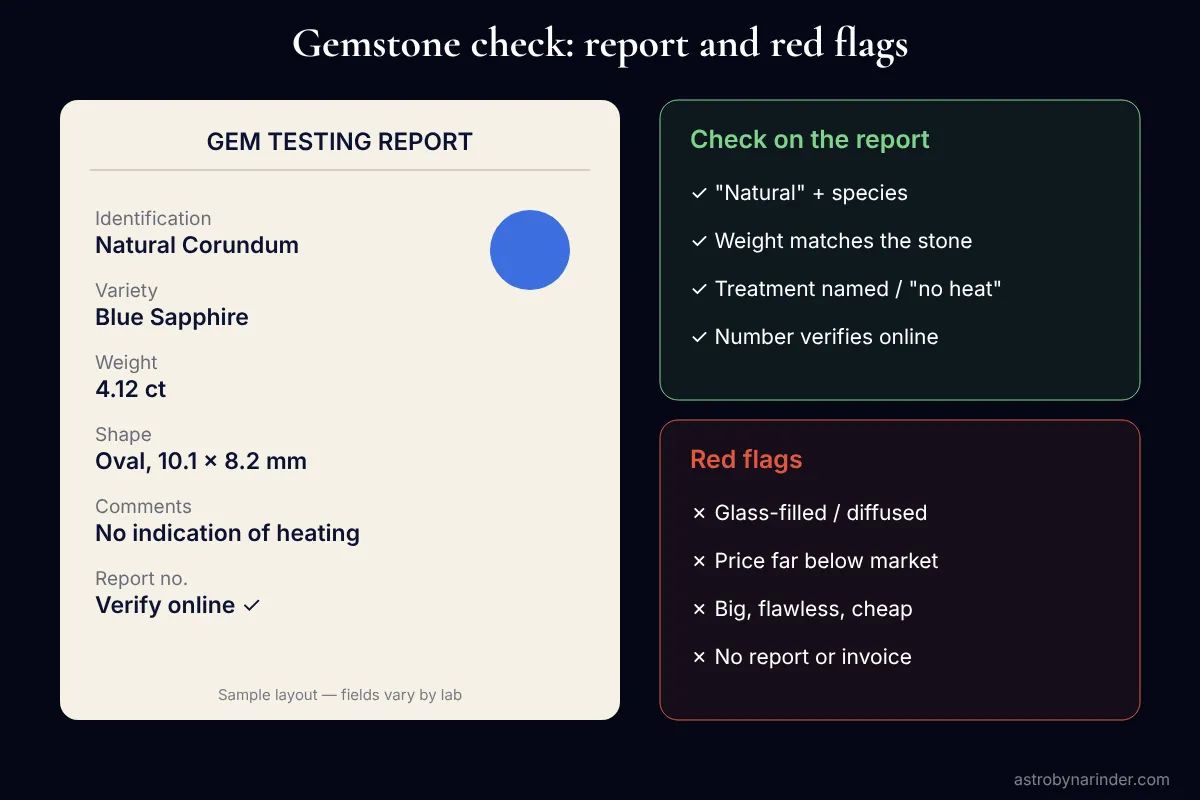
The only reliable way to know if a gemstone is natural and untreated is a report from a recognised gem-testing laboratory. The report should say "natural" (not synthetic or imitation), name the species and variety (for example, natural corundum — blue sapphire), state the weight and dimensions, and say whether the stone shows "no indication of heating" or lists treatments such as heat, glass-filling or diffusion. Home tricks — fire, water or "scratch" tests — cannot tell natural from synthetic and can damage the stone.
People spend thousands on a pukhraj or neelam and later find it was glass-filled or synthetic. A few simple checks prevent that.
What a Lab Report Should Show
| Field | What to look for |
|---|---|
| Identification | "Natural" + species (corundum, beryl, chrysoberyl…) and variety (ruby, sapphire, emerald…) |
| Weight | Carats, matching the invoice and the stone on a scale |
| Dimensions & shape | Should match the stone you're given |
| Treatment / comments | "No indication of heating", or the treatment named |
| Photo & report number | Photo should match; number should be verifiable on the lab's website |
Common Treatments
| Treatment | Common in | Astrology view |
|---|---|---|
| Heating | Sapphire, ruby | Widely accepted; unheated preferred and costlier |
| Glass / lead-glass filling | Ruby, sometimes sapphire | Avoid — large share of the "stone" is glass |
| Beryllium / surface diffusion | Sapphire | Avoid — colour is added, not natural |
| Oiling / resin | Emerald | Minor oil common; heavy resin filling less preferred |
| Dyeing | Coral, some quartz | Avoid |
| Cultured | Pearl | Most pearls sold are cultured; natural pearls are rare and expensive |
Red Flags When Buying
- Price far below market for that size and colour.
- A large, very clean stone at a modest price — natural stones usually show some inclusions.
- Round gas bubbles or a glassy flash under a loupe — signs of glass or filling.
- No invoice with weight, or a report you can't verify online.
- Seller avoids naming the treatment.
Home Tests: Myths
- "Real stones don't heat up / don't burn." — Synthetic stones behave the same; fire can crack a real one.
- "Real pukhraj turns milk yellow." — No scientific basis.
- "Scratch test." — Synthetics have the same hardness and you can damage the stone.
Only lab instruments (spectroscopy, microscopy) can reliably separate natural, synthetic and treated stones.
Buying Checklist
- Get the right stone for your chart first — read Which Gemstone Should I Wear?
- Ask for a lab report and verify it online.
- Match weight and shape with the report.
- Get an invoice with the report number.
- Prefer unheated for pukhraj and neelam if the budget allows; avoid glass-filled or diffused stones.
A Worked Example
An example (not a real client): a "5-carat neelam" offered for a very low price with no report.
- A lab check showed natural sapphire, beryllium-diffused — colour added on the surface.
- The buyer chose a smaller 4-carat, heated, natural stone with a verified report instead — within budget and suitable for astrological use.
More on specific stones: Neelam, Pukhraj, Navratna.
Get the Right Stone for Your Chart
A natural stone only helps if it's the right planet for you. See Gemstone Recommendation, or book a 1:1 session. Gemstones are a traditional support, not medical treatment — see our disclaimer.
Frequently Asked Questions
How can I check if a gemstone is real?
Are heated gemstones okay for astrology?
Do home tests like the fire or water test work?
What does "no indication of heating" mean?
Is a cultured pearl acceptable for astrology?
What are red flags when buying a gemstone?
By Narinder
Vedic astrologer, practising since 2016 — kundli reading, matching, vastu, numerology, gemstones, remedies and dowsing healing, online by phone or Zoom. Guidance only; see our disclaimer.