
Birth Time Rectification: What It Is and When You Need It
By Narinder, Vedic astrologer · Updated · 5 min read

Key takeaways
- Needed when the birth time is unknown, rounded (like 12:00) or disputed.
- Uses dated life events + dashas, transits, D9/D10 to test candidate times.
- Bring a time window and 6–10 events with dates (month and year at least).
- The result is the most likely time — not a certainty.
- A rectified time makes dasha dates, D9 and predictions far more reliable.
In this article
Birth time rectification is the process of finding your most likely exact birth time when it is unknown, approximate or doubtful. An astrologer takes a time window (for example, "early morning, 5–7 am") and tests possible times against 6–10 major dated events in your life — marriage, children, job changes, moves, accidents, a parent's passing — using dashas, transits and divisional charts. The time that explains the events best is adopted. It's needed because the ascendant changes about every 2 hours and the navamsa about every 13 minutes.
"Mummy ko bas itna yaad hai ki subah ka time tha" — this is very common. Without a reliable time, the ascendant, houses and dasha dates can all be off. Rectification is how astrologers deal with it.
When Do You Need Rectification?
- No birth time at all, or only "morning / evening".
- A rounded time — 12:00, 6:00, 9:30 — often a guess.
- Two different times from family members or documents.
- Birth near a sign change — the ascendant could be either of two signs.
- Predictions keep missing even though the chart looks reasonable.
How the Process Works
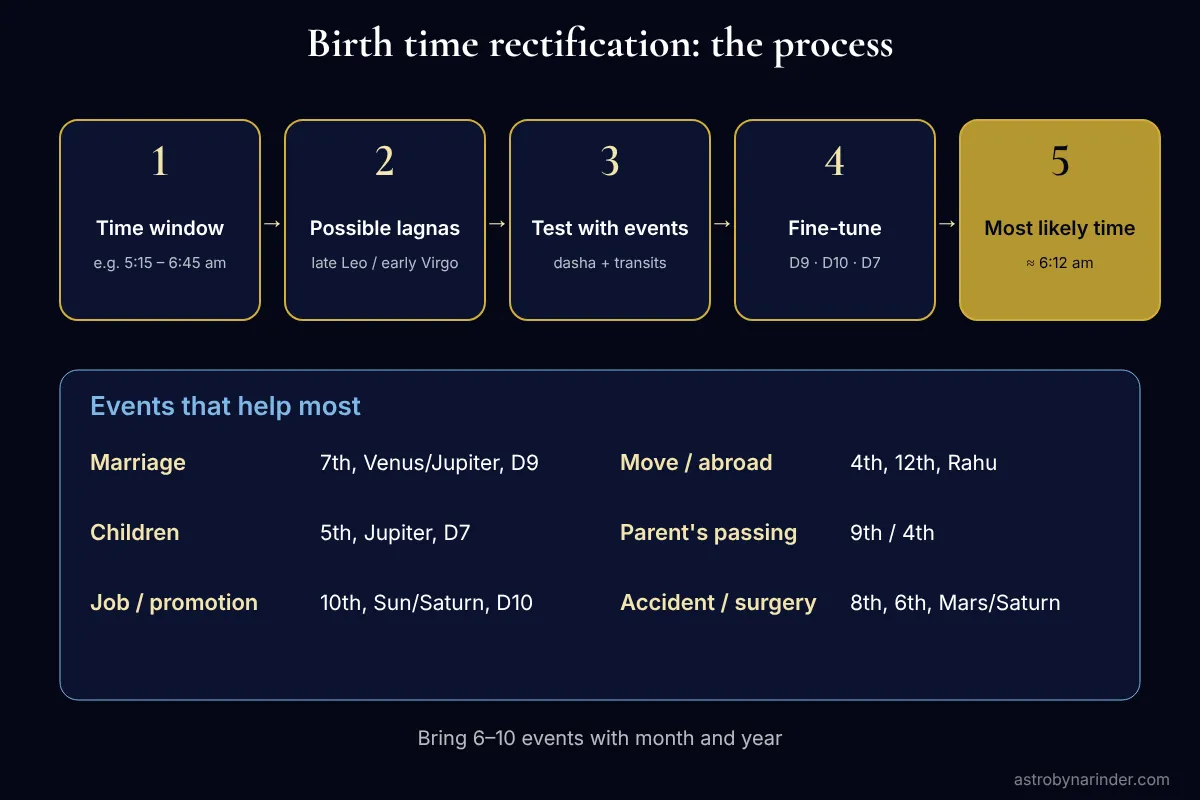
- Set the window — the range the time could be in.
- Find the possible ascendants in that window (often only one or two).
- Test each candidate against your events: did the right dasha run at marriage? Did Saturn/Jupiter transits hit the right houses at a job change or move?
- Fine-tune with divisional charts — D9 (marriage), D10 (career), D7 (children).
- Cross-check with physical build and temperament for the ascendant.
Which Life Events Help Most
| Event | Houses / factors checked |
|---|---|
| Marriage | 7th house, Venus/Jupiter, D9 |
| Birth of children | 5th house, Jupiter, D7 |
| First job / big promotion | 10th house, Sun/Saturn, D10 |
| Moving home or abroad | 4th and 12th houses, Rahu |
| Parent's passing | 9th (father) / 4th (mother) and their maraka houses |
| Accidents / surgery | 8th and 6th houses, Mars/Saturn |
| Education milestones | 4th, 5th, 9th houses |
Give month and year at least; exact dates are better. Events with clear dates help more than vague ones.
What It Can and Can't Do
- It gives the most likely time that fits your life — not a guaranteed one.
- With good events, the result is usually reliable to a few minutes.
- With few events (for example, a young person), the window may stay wider.
- Different methods (Parashari, KP, Nadi) may differ slightly; a careful astrologer tells you how confident the result is.
A Worked Example
An example (not a real client): time remembered as "around 6 am", window 5:15–6:45 am.
- The window gives two possible ascendants: late Leo or early Virgo.
- Marriage in 2019 came in a Jupiter–Venus period. With the Virgo ascendant, Jupiter rules the 7th and Venus the 2nd and 9th — a strong marriage link. With Leo, Jupiter rules the 5th and 8th and Venus the 3rd and 10th — a weaker fit.
- First child in 2021 and a move abroad in 2023 also fit the Virgo candidates.
- Fine-tuning with D9 and D7 narrows it to about 6:12 am.
What to Prepare
- Date and place of birth, and the time window.
- A list of 6–10 events with dates.
- Any document times (hospital record, horoscope made at birth).
Get Your Birth Time Checked
If your time is uncertain, rectifying it first makes every other reading — dasha timing, navamsa for marriage, career — much more accurate. See Kundli Reading, or book a 1:1 session. Need matching without a time? Read Kundli Matching Without Birth Time.
Frequently Asked Questions
What is birth time rectification?
When is birth time rectification needed?
What information is needed for rectification?
How accurate is birth time rectification?
Can rectification be done without any birth time?
Why does a few minutes' difference matter?
By Narinder
Vedic astrologer, practising since 2016 — kundli reading, matching, vastu, numerology, gemstones, remedies and dowsing healing, online by phone or Zoom. Guidance only; see our disclaimer.